
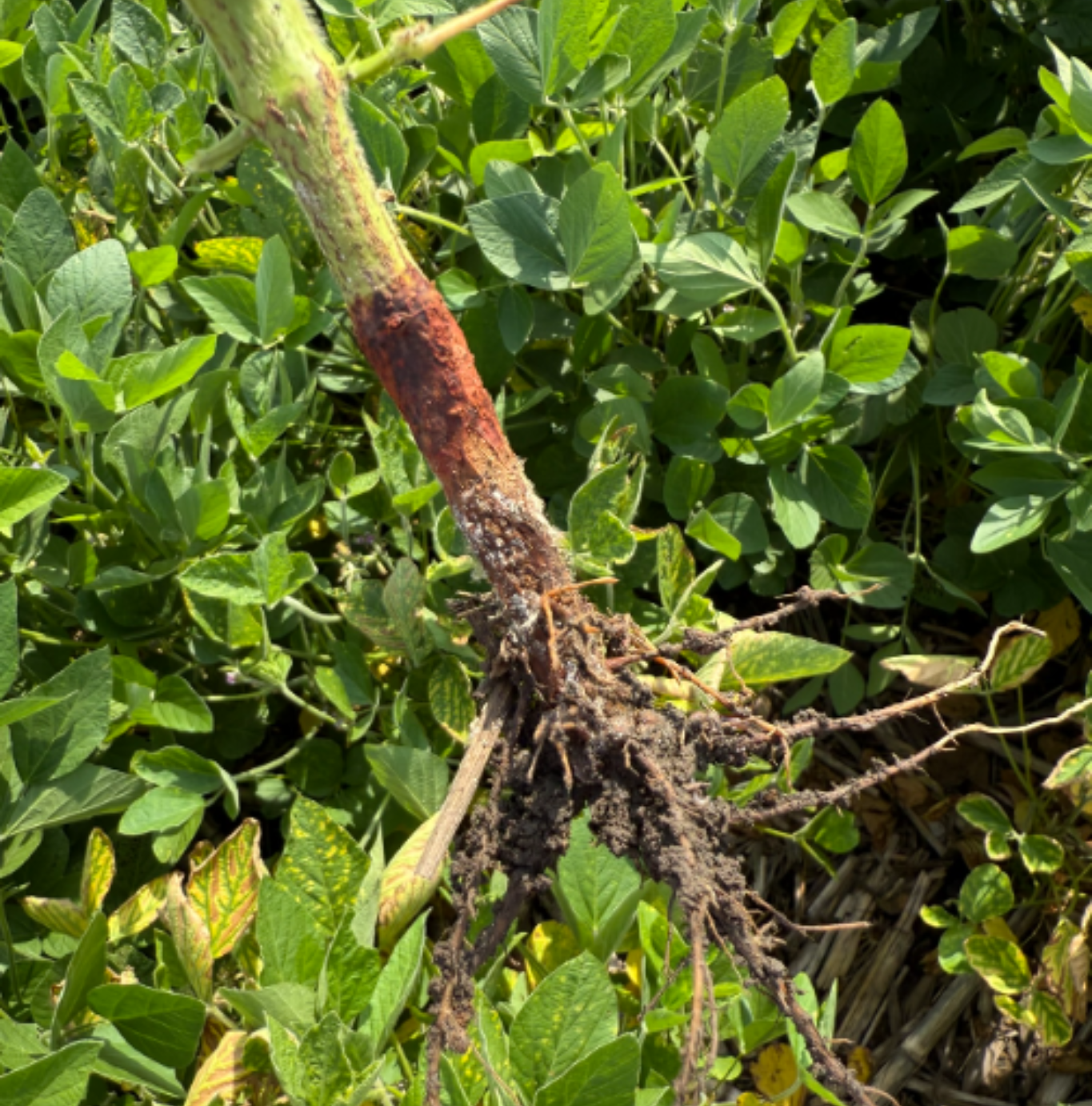
Red crown rot (RCR) is becoming a growing problem in Illinois soybean fields. In some cases, it can cause significant yield loss of up to 70%. But one of the biggest challenges is that it often goes unnoticed until it is too late. Unlike many diseases, RCR does not spread evenly across a field. It develops in patches, creating hotspots that are easy to miss with traditional scouting.
Research at the University of Illinois, funded by the Illinois Soybean Checkoff program, focuses on improving early detection of RCR and mapping where it occurs within fields using satellite imagery and artificial intelligence.
Using satellite data, the research team can identify subtle changes in crop growth and canopy reflectance associated with disease stress. These tools allow researchers to distinguish healthy from diseased areas and estimate how much of a field is affected (Figure 1). This matters because disease is often limited to a small percentage of the field.
WHY THIS MATTERS FOR FARMERS
Most management decisions, such as seed treatments, are applied uniformly across the field. However, the return on that investment depends heavily on how much area is affected.
In commercial fields, yield losses of up to 70% have been observed when comparing plants within RCR hotspots to nearby asymptomatic plants. However, these losses occur at the plant or patch level. The overall impact on field yield depends on how much of the field is affected; that is, the percentage of area occupied by these hotspots.
By combining satellite detection with field validation and yield data, this project aims to answer key questions:
- How much of my field is affected by RCR?
- Is disease pressure high enough to justify treatment?
- Where should I focus scouting and management?
- What is the estimated yield loss at the field scale?
In addition, identifying hotspots within fields can help guide more targeted management strategies. These might include focused scouting efforts or application of more intensive management practices in those areas, including higher rates of in-furrow fungicide applications.
The goal is to move toward data-driven, field-specific decisions rather than relying on assumptions of uniform disease pressure across the field.
TRACKING DISEASE OVER TIME
One important finding from this research is how quickly RCR can expand within a field.
At one Illinois location, satellite analysis showed diseased area increasing from about 6% of the field in 2022 to 26% in 2024.
Beyond documenting this expansion, current efforts aim to estimate how the disease is likely to spread over time under different scenarios, including with and without management interventions. This type of information can help evaluate the potential benefits of timely management and guide decisions on when and where to act.
Together, these insights highlight risk and reinforce the importance of early detection and continued monitoring.
HOW YOU CAN HELP
Researchers are currently looking for farmers interested in participating during the 2026 growing season. Fields with known or suspected RCR are especially valuable for improving and validating these tools under real-world conditions.
Participation will help:
- Improve detection accuracy
- Expand validation across Illinois environments
- Support development of practical decision tools for farmers
If you are interested in participating or learning more, contact me, Dr. Boris Camiletti, at bxc@illinois.edu.
LOOKING AHEAD
RCR is a challenging disease, but new technologies are changing how it can be understood and managed.
Ongoing work is expanding beyond detection to incorporate environmental and agronomic factors, including soil moisture, temperature, topography (Figure 2), and field management practices that influence disease development and spread. Integrating these variables with satellite data will improve the ability to predict where and when disease risk is highest.
By combining satellite imagery, field research, environmental data and agronomic information, this project aims to provide farmers with clearer, more practical tools to anticipate disease pressure, target management strategies and improve return on investment.
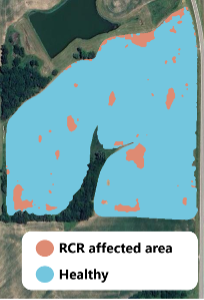
Figure 1. Satellite map showing patches of red crown rot in a soybean field.
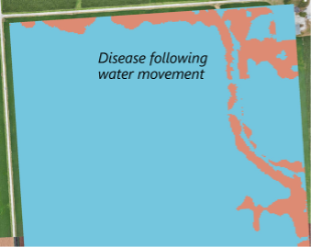
Figure 2. Satellite map showing red crown rot spreading along water movement patterns within the field (orange = RCR-affected areas, blue = healthy areas)
Recent Articles
What makes Illinois soy stand out on the national and global stage? From our unmatched transportation network to innovative infrastructure projects, Illinois moves soy efficiently and effectively.
By
Where Illinois soy stands today - and where it's headed.
By IL Field & Bean Team