

Try these tested principles for soybean operation stability.
Crunching numbers and mitigating risk on the farm has never been for the faint of heart. And in today’s ag economy, young farmers in particular face a dizzying array of challenges including razor-thin margins, rising machinery costs and geopolitical shocks.
But it turns out you don’t need to be a spreadsheet genius to be a successful farmer. Instead, experts advise, you need to return to first principles.
For Illinois soybean farmers, especially the next generation stepping into larger management roles, the challenge is to think both traditionally and differently simultaneously. Long-term profitability is still built on disciplined cost control, careful liquidity management and sober risk-taking.
It also helps if you have the confidence to go against the grain when the crowd is chasing growth, expensive land or the latest shiny input without a clear return.
“You operate in a commodity market… and margins in commodity markets, generally, historically have always been very thin, and I expect that to continue in the future,” says Dr. Scott Irwin, professor and Laurence J. Norton Chair of Agricultural Marketing at the University of Illinois. “That’s your reality of your basic operating environment.”
The new age of farm finance doesn’t require a clean break from the past. Instead, it requires a return to a battle-tested playbook that reveals how to stay profitable, resilient and ready for opportunity.
“Cost management is key,” says Dr. Gary Schnitkey, professor and Soybean Industry Chair in Agricultural Strategy at the University of Illinois. “We see large differences in cost management across [the Farm Business Farm Management (FBFM) program] grain farms, with lower-cost farms having much higher chances of profitability and financial success.”
Thin Margins, Long Cycles
If there is one reality both experts return to again and again, it’s that farm finance starts with understanding the business you’re in. Illinois soybean farmers operate in a global commodity market, so outside forces such as world events and domestic policy shifts can hit profitability fast.
Irwin argues that younger farmers, especially those who have come of age during relatively stronger years, need to understand how normal it is for agriculture to move in cycles. Some years bring rare pricing opportunities. Others demand patience, discipline and endurance.
“Their historical pattern is… relatively brief periods of spiking high prices. And then extended periods of prices at or below cost of production,” Irwin explains.
That long view matters. It can be tempting to make decisions based on the last two or three years, especially when the operation is growing or the pressure is on to prove momentum. But decisions built for a short-term price environment can become liabilities when the cycle turns. The modern farm may have more data, more tools, and more sophisticated financial products than previous generations had, but it is still vulnerable to the same old trap: confusing a favorable window with a permanent new normal.
Prioritize Returns Over Raw Yield
That’s why cost control should be your first farm-finance priority. Profitability gaps between farms often come down to management of expenses, not simply gross production, Schnitkey points out.
“I would suggest the emphasis should be on ‘maximizing returns and not yields,’” he says. “It is quite easy to add a chemical treatment, fertilizer application or seed treatment that may contribute to yields but does not carry its weight in terms of returns.”
That mindset has implications all across your farm. It applies to fertility programs, pesticide passes, seed decisions, family living expenses and especially machinery, these experts say.
“Our work here at the University of Illinois using FBFM records shows that the No. 1 predictor of profitability across farms in Illinois is machinery costs,” Irwin says.
That doesn’t mean you should never upgrade equipment or invest in technology. It simply means right-sizing those investments based on the actual economics of the acres being farmed.
Guard Your Financial Cushion
Liquidity and working capital deserve close attention alongside production costs. In a difficult year, they’re often the difference between flexibility and vulnerability.
Schnitkey warns against using working capital on purchases that do not have a clear line to improved profitability. That is especially relevant today amid high input and machinery costs plus the social pressure young farmers face to invest in assets that signal seriousness or growth.
“Anything that is purchased, thereby depleting working capital, should be judged on its ability to return funds to an operation,” Schnitkey says.
He recommends that over time, farmers track at least one key measure of solvency, liquidity and cost efficiency. Debt-to-asset ratio, current ratio, operating expense ratio, net farm income, and net worth trends all help tell the story. (See sidebar for definitions and examples.)
Be honest with yourself and your balance sheet. Your goal stability over a long time horizon, not perfect financial management each year. Ask yourself some pointed questions:
- Is the farm’s liquidity improving, holding steady or slipping?
- Is solvency strengthening over time, except when expansion is deliberately undertaken?
- Are costs moving in a direction the business can sustain?
Schnitkey offers one especially practical benchmark: “Overall, we would like to see the operating expense ratio to be less than 0.8. That [has been] a very tough benchmark to reach in the last several years,” he acknowledges.
Growth Requires Discipline
Maintenance of a stable balance sheet is even more urgent if you are exploring ways to expand your farming operation. Growth is often necessary to make a farm viable and to cover family income needs, but expansion also carries risks.
“Young producers need to grow the farm to be successful, but expansion needs to be done carefully in today’s environment,” Schnitkey says.
Several tripwires are especially common for young producers, says Irwin, who for decades has managed his family’s Iowa farm finances including all commodity marketing.
“The three most important decisions, and the easiest places to make mistakes for young farmers … [are] getting power costs too high, too aggressive, too young; bidding too aggressively for cash rent; [and] too aggressive, too soon on buying land,” he says.
Sometimes, the strongest financial move looks the least aggressive. You might need to walk away from overpriced rent, delay a land purchase or resist the urge to build a budget that assumes a best-case revenue scenario.
Schnitkey is particularly skeptical of taking losses on rented farmland in the hope that things will work out later. “At today’s cost, renting farmland at higher-than-average cash rents will result in losses given today’s expected prices,” he cautions.
Market With Humility
To smartly sell your soybeans and other commodities you raise, it’s important to be clear about the game you’re playing, Irwin says. That’s because when you know the rules, you can manage the risks that follow.
“You’re in a million-dollar poker game against the best poker players in the world in the grain industry,” Irwin explains. “You do not have to belly up to the million-dollar poker table.”
In other words, you don’t need to try to game the market and wait for the ultimate peak price to sell. Instead, think seriously about implementing a passive marketing strategy such as selling a portion of your crop at harvest or averaging sales out over time. Then, stick to that plan consistently.
On his own family’s farm, Irwin uses such a hybrid approach. He likes to have 20% to 25% of the crop sold before July or August. Then, he spreads out harvest and post-harvest sales so the farm naturally captures favorable returns, on average, over time.
From there, he uses a longer-term price-band framework to guide more aggressive sales when markets offer unusually positive opportunities.
“When we’re way up at the upper part of the band, I am an aggressive seller,” Irwin says. “You’ll never go broke selling $6 corn.” The same can be said for selling soybeans when they hit $14.50 per bushel or higher, he adds.
Rather than playing markets aggressively, focus your energy on becoming highly skilled at cost control, crop insurance and government program strategy.
“I would want to become an expert in those areas before I worried too much about becoming an expert playing the million-dollar poker game.
Build Buffers Before Trouble
Your farm’s finances also are susceptible to events beyond your control, which means you must bake flexibility into your balance sheet. World conflicts can move fertilizer and fuel markets, as the war in Iran has done. Federal assistance programs might or might not continue. And policy decisions in biofuels can change demand expectations.
Fertilizer, in particular, is one area where more conservative planning often makes sense, Irwin says. It’s a good idea to purchase between half and two-thirds of your fertilizer needs before planting season. You can hold off on buying the balance in case favorable prices emerge.
Also be aware of potential downside risks hiding in your farm’s numbers, Schnitkey advises. Did working capital decline? Did solvency worsen? Did net worth fall?
“A farm with any one of the above occurring should look at ways of modifying the operation to cause that trend to discontinue,” he advises.
Begin Succession Conversations Now
For younger farmers transitioning into management, there’s one more layer to farm finance that spreadsheets alone cannot solve: your family’s expectations about where you’ll fit into the operation.
Successful transitions depend on honest conversations about how ownership, decision-making and succession will evolve with time.
“Both generations need to discuss how transitions will be made,” Schnitkey says.
Your role as your operation’s financial steward might not be easy. But these experts express optimism that with study, practice and discipline, it’s completely possible to be a great manager using basic principles and tools available right now.
“We are in a difficult economic time for Illinois producers,” Schnitkey acknowledges. “Still, Illinois agriculture has weathered these before, and we continue to see financial resilience among farmers.”
Sidebar: Free Farm Finance Resources for Your Operation
Boosting your farm’s financial position starts with access to better information. These practical resources can help you build financial clarity, benchmark your farm’s performance against other operations and sharpen your decision-making.
- Illinois Farm Business Farm Management (FBFM)
A strong starting point for preparing financial statements and understanding whole-farm performance over time. To learn more, visit https://fbfm.org. - farmdoc
The University of Illinois hub for farm management analysis, market commentary and decision tools. To learn more, visit: https://farmdoc.illinois.edu - FAST Tools
A suite of calculators and spreadsheets designed to help farmers analyze key financial and management decisions. To learn more, visit: https://farmdoc.illinois.edu/fast - Grain Farm Projections Tool
Build projected cash flows and evaluate how a rental, purchase, or other decision might affect your business. To learn more, visit: https://farmdoc.illinois.edu/fast-tools/farm-projection-tool - Crop insurance resources on farmdoc
Helpful for comparing insurance options and understanding how insurance decisions interact with farm-program support.
Learn more: https://farmdoc.illinois.edu
Sidebar: Farm Finance Terms Next-Gen Farmers Should Know
Here are a few common terms in farm finance shared by Dr. Scott Irwin and Dr. Gary Schnitkey of the University of Illinois. Commit these to memory and you’ll be able to spot risk earlier, ask better questions and make stronger business decisions.
- Cash-flow budget — A forward-looking test of whether a major decision actually works on paper before it is made. “A young producer should conduct a cash-flow budget [before] renting the farmland,” Schnitkey says.
- Current ratio — A common measure of liquidity that compares your current assets to your current liabilities.
- Debt-to-asset ratio — A key solvency metric that shows how much of your operation is financed by debt. “During most years, debt-to-asset ratios should be declining,” Schnitkey says.
- Liquidity — Your farm’s ability to meet short-term financial obligations without strain.
- Operating expense ratio — Operating expenses divided by gross farm returns. It’s a useful measure of cost efficiency.
- Power cost per acre — Machinery and equipment costs spread across the acres you farm. It’s often one of the biggest drivers of profitability, Irwin says.
- Solvency — A measure of long-term financial strength and debt load.
- Working capital — The cash that helps your farm absorb stress and keep operating smoothly.
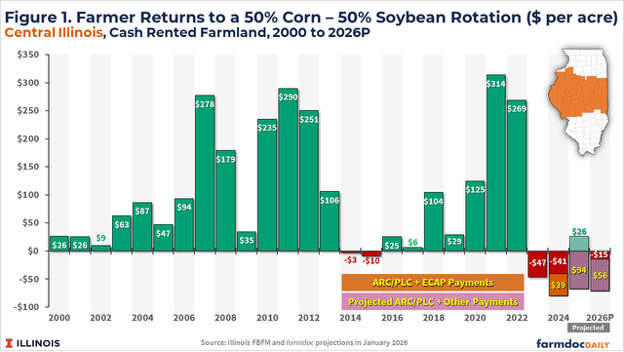
A return to farm finance fundamentals is essential in a year such as 2026, when marginal commodity price improvements are expected to be offset by small increases in overall costs, assuming yields at trend levels. Break-even prices to cover all costs including land are between $4.70 and $4.90 for corn and between $10.80 and $11.25 for soybeans without government support, farmdocDaily reports. That’s well above anticipated pricing opportunities for the 2026 crop. Source: farmdocDaily
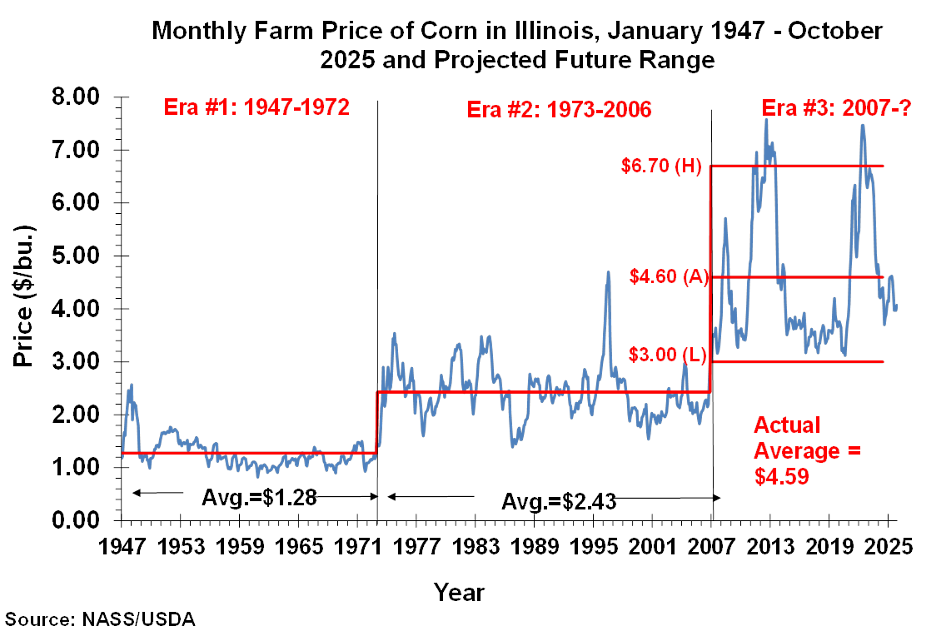
To bring stability to your commodity marketing strategy, consider a hybrid approach, says Dr. Scott Irwin of the University of Illinois. One example: Have specific seasonal targets for selling a defined percentage of your crop. Then, confirm when prices have hit highs using a price-band chart such as this one, and sell remaining crop aggressively during rare price peaks. Source: farmdocDaily

Dr. Scott Irwin, University of Illinois. Credit: University of Illinois

Dr. Gary Schnitkey, University of Illinois. Credit: University of Illinois
Recent Articles
What makes Illinois soy stand out on the national and global stage? From our unmatched transportation network to innovative infrastructure projects, Illinois moves soy efficiently and effectively.
By

Where Illinois soy stands today - and where it's headed.
By IL Field & Bean Team