
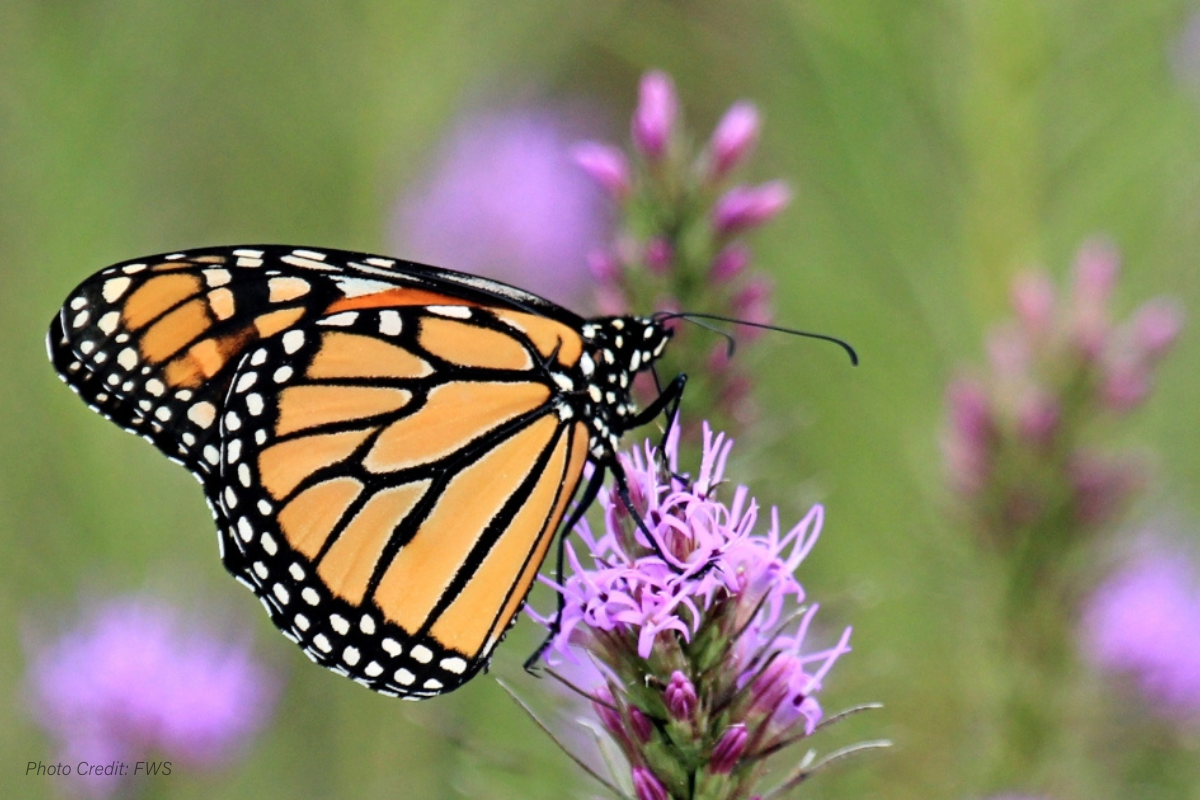
The monarch butterfly, likely the most famous butterfly in North America, will soon receive federal protections under the Endangered Species Act (ESA). In December, the U.S. Fish and Wildlife Service (FWS) decided that listing the monarch under the ESA as a threatened species was warranted, proposing a rule to list the species in the Federal Register on December 4.
As farm policy, pesticide regulation and public health debates swirl in Washington, Illinois farmers need clarity on how D.C. conversations could impact their operations. Today’s regulatory landscape touches everything from monarch butterflies fluttering through our fields to the herbicides and insecticides we rely on, and even the foods Americans eat. Here’s a rundown of three key developments—and why you should be paying attention.
Monarch Butterfly Proposed Listing by U.S. Fish and Wildlife
The monarch has two main populations. The Eastern population—covering much of the Midwest, including Illinois—is the most iconic and widely followed by the public. It completes a remarkable multi-generational migration each year— traveling from overwintering sites in Mexico, through the U.S. and into Canada, before returning to Mexico—posing unique conservation and monitoring challenges. In contrast, the second population, the Western Monarchs, reside west of the Rocky Mountains, overwinter along the California coast and migrate shorter distances.
The Eastern Monarch population is monitored by collaboration between the World Wildlife Fund, Mexico’s National Commission of Natural Protected Areas (CONANP) and others. The most recent published monarch count shows a near doubling of the population— occupying 4.42 acres of forest in Mexico, up from 2.22 acres last year. These estimates are based on the area of forest canopy covered by overwintering monarch butterflies. Recent counts are encouraging, showing the potential for conservation success.
The Xerces Society recently released data from its annual Western Monarch Count, a community science effort that tracks the Western Monarch population along the California coast. This report showed a record-low count of just 9,119 monarchs, down sharply from 233,394 the previous year. This sharp decline comes after a few years of modest recovery, underscoring the volatility of this population.
Shift to ‘Threatened’ Still Poses Challenges
Both monarch butterfly populations have recently been proposed to be listed as threatened under the ESA by the U.S. FWS. A “threatened” listing— unlike “endangered”—allows for greater regulatory flexibility through what’s known as the “4(d) rule.” Under this rule, the U.S. FWS can tailor restrictions and include exceptions for certain activities, such as those related to agriculture. While the “threatened” listing is preferred, there is still reason to be concerned:
FWS’s proposed rule includes restrictive language on land conversion, potentially limiting farmers’ ability to transition land to and from agricultural use. Additionally, the ambiguity around the term “conversion” leads to confusion and might discourage involvement in other government conservation programs.
The FWS did not provide an exception to pesticide use in the proposed rule. This has created confusion about how a listing will impact farmers’ access to pesticides. Complicating matters, overlapping U.S. Environmental Protection Agency (EPA) pesticide mitigation strategies on insecticides and herbicides make it difficult for farmers to know how to adapt.
Illinois Soybean Growers (ISG)—the voluntary member-funded advocacy arm of the Illinois Soybean Association— has been actively engaging with the U.S. FWS through public comments and other channels to ensure farmer concerns are heard. In collaboration with other agriculture groups, we’re advocating for a clear, farmer-friendly final decision—expected sometime in early 2026.
EPA’s Final Insecticide Strategy
The Final Insecticide Strategy is the EPA’s blueprint ensuring insecticide labels comply with the ESA. It aims to reduce spray drift and runoff risks to hundreds of listed species and their habitats. Developed in tandem with the Final Herbicide Strategy released last year, this plan will guide label changes on products as they come up for registration or re-evaluation.
Key Features
- Mitigation Point System: As new labels are published, each insecticide product will carry a mitigation requirement (0–9 points) based on the product’s toxicity and potential to move off-site. Farmers can meet these requirements by implementing approved practices from a picklist of mitigation measures provided by the EPA.
- Pesticide Use Limitation Areas: The EPA will designate Pesticide Use Limitation Areas (PULAs), geographic zones where targeted mitigation is required to ensure protection of listed species. EPA is developing mapping tools to help farmers identify PULAs and understand what actions are needed in those areas.
Why It Matters
For Illinois farm operations, understanding this strategy is critical. Virtually every county contains at least one threatened or endangered species—and non-compliance with future label requirements could affect product access or eventually lead to enforcement action. Farmers can start planning now—by evaluating fields and consulting advisers—to integrate mitigation measures before new labels take effect.
Make America Healthy Again Commission Report
In May, the Make America Healthy Again (MAHA) Commission released its assessment on the U.S. childhood chronic disease crisis which is expected to be followed with policy recommendations by the end of August.
Initial reviews found fundamental flaws with the report. For example, the report has been criticized for misrepresenting or misquoting scientific studies. In fact, some citations are decades old or based on outdated products and uses. Even more concerning, some cited studies appear to be unverifiable or non-existent. Observers have suggested these errors may be “hallucinations” by artificial intelligence used to write the report.
The report expressed worry about “modern seed oils” (e.g., soybean, canola and corn oil), suggesting reduced use. It also questioned whether federal programs such as crop insurance indirectly support inclusion of seed oils in unhealthy diets.
The Commission also raised concerns about widely used herbicides—particularly glyphosate and atrazine—despite repeated safety findings from the U.S. EPA and, notably, the European Union, which recently re-approved glyphosate for use.
The Commission is scheduled to issue a follow-up report with policy recommendations by the end of August. In response, farm organizations, including ISG, have made significant efforts to ensure any final recommendations reflect science-based, farmer-informed input.

Recent Articles
What makes Illinois soy stand out on the national and global stage? From our unmatched transportation network to innovative infrastructure projects, Illinois moves soy efficiently and effectively.
By

Where Illinois soy stands today - and where it's headed.
By IL Field & Bean Team