
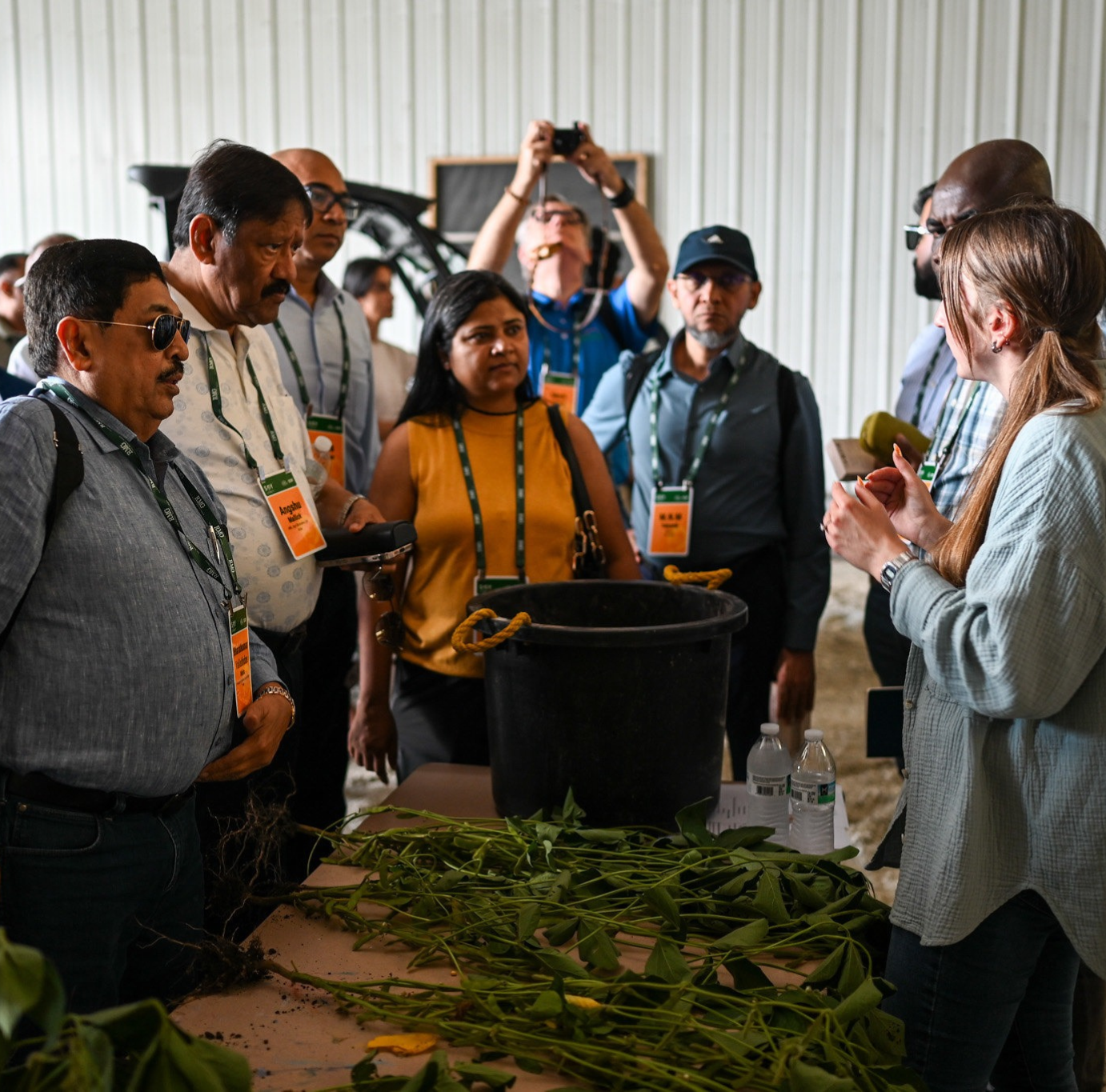
On August 4, more than 500 soybean buyers from nearly 60 countries experienced Illinois agriculture firsthand as Illinois Soybean Association (ISA) team members helped kick off the U.S. Soybean Export Council’s (USSEC) 2026 Soy Connext Conference in Chicago.
Ahead of the conference, ISA’s Market Development team coordinated three simultaneous farm tours, hosted by Illinois soybean farmers Ryan Frieders, Dale Pitstick and Jeff O’Connor. The visits provided international buyers with an up-close look at modern soybean farming in Illinois and the practices that position the U.S. as a reliable supplier in the global marketplace.
Throughout the tours, participants learned about farm equipment and precision agriculture technology, soybean production practices, market demand and Illinois’ transportation infrastructure. ISA staff and industry experts also shared insights on topics including sustainability, agronomy, diversification, food-grade soybeans and soybean oil.
The tours served as an opportunity for attendees to connect directly with Illinois farmers and gain a deeper understanding of the innovations, stewardship practices and supply chain efficiencies that support U.S. soybean production. The visits were met with positive feedback, with many buyers praising both the educational programming and the chance to see Illinois agriculture in action.
“Farm visits are such a good opportunity to tell our story,” said Roberta Simpson-Dolbeare, an Illinois farmer and USSEC Vice Chairwoman. “Illinois and U.S. farmers have a lot to be proud of. From how we grow our soybeans to how we operate our farms, we’re planning ahead so the next generation can continue farming. We take care of our soil and try to do things the right way, preserving not only our land but also operating efficiently so we can continue to have the high percentage of family farms in Illinois that we do today.”
The Soy Connext Conference officially began Wednesday with the annual USSEC Board Meeting, Trade Team Invitational and SEC GAP meeting. This year’s conference set an attendance record, with over 800 U.S. soy buyers, sellers, growers and visionaries present to spark innovation, open new markets and shape the future of soy together. This year was also the first time Soy Connext was hosted in Illinois, the No. 1 soybean-producing state in the U.S.
“It’s great to be here in Chicago. I know people around the world, and certainly myself too, think of Chicago as a hub for commodity trading. When we think about where to host the Soy Connect events, we look for a place that has good transportation, a place where people would like to go, and a place that has facilities where we can host this sort of event,” said Jim Sutter, CEO of USSEC. “Also, the other benefit is the great partnership we’ve had with the Illinois Soybean Association, and the great farm tours that we were able to organize. Thank you to Illinois for being such a good partner and a good host,” he added.
Over the following two days, keynote presentations and breakout sessions explored a variety of topics impacting global agriculture and trade, including geopolitics, global supply and demand, the 2026 growing season, specialty soybeans, feed cost dynamics, consumer trends, the Sustainable U.S. Soy label, corporate transparency, and opportunities within the energy, biofuels and crush sectors.
Throughout the conference, ISA team members also met with representatives from Vinh Hoan, a leading aquaculture company in Vietnam, COFCO, China’s largest food and agriculture company, and CP, one of Southeast Asia’s largest fish, poultry and pork producers. Discussions focused on strengthening relationships and expanding opportunities for U.S. soy in international markets. Team members also engaged with visitors at ISA’s booth, highlighting the International Commercialization Initiative (ICI) and its role in supporting global market development efforts, as well as ISA’s Soy Innovation Center and It’s Sustainably Soy-certified products.
“Meeting with buyers in person is a great opportunity to not only share our personal farming story, but also to explain why U.S. soybeans are top of the line. We can point out the quality differences in our sustainably raised soybeans and explain the four Ds, which help show why U.S. soybeans are better than those grown in other countries. U.S. soybeans are naturally dried in the field, resulting in less damage to the beans. Because they are dried more naturally, they store better and are more digestible. There is also no deforestation involved. Those are the key points that really help when meeting buyers face to face,” said Simposon- Dolbeare.
From hosting farm tours and engaging global customers to participating in high-level trade discussions, ISA played an important role throughout Soy Connext, helping showcase the value, reliability and sustainability of Illinois soybeans to a worldwide audience.
Recent Articles
What makes Illinois soy stand out on the national and global stage? From our unmatched transportation network to innovative infrastructure projects, Illinois moves soy efficiently and effectively.
By
Where Illinois soy stands today - and where it's headed.
By IL Field & Bean Team