
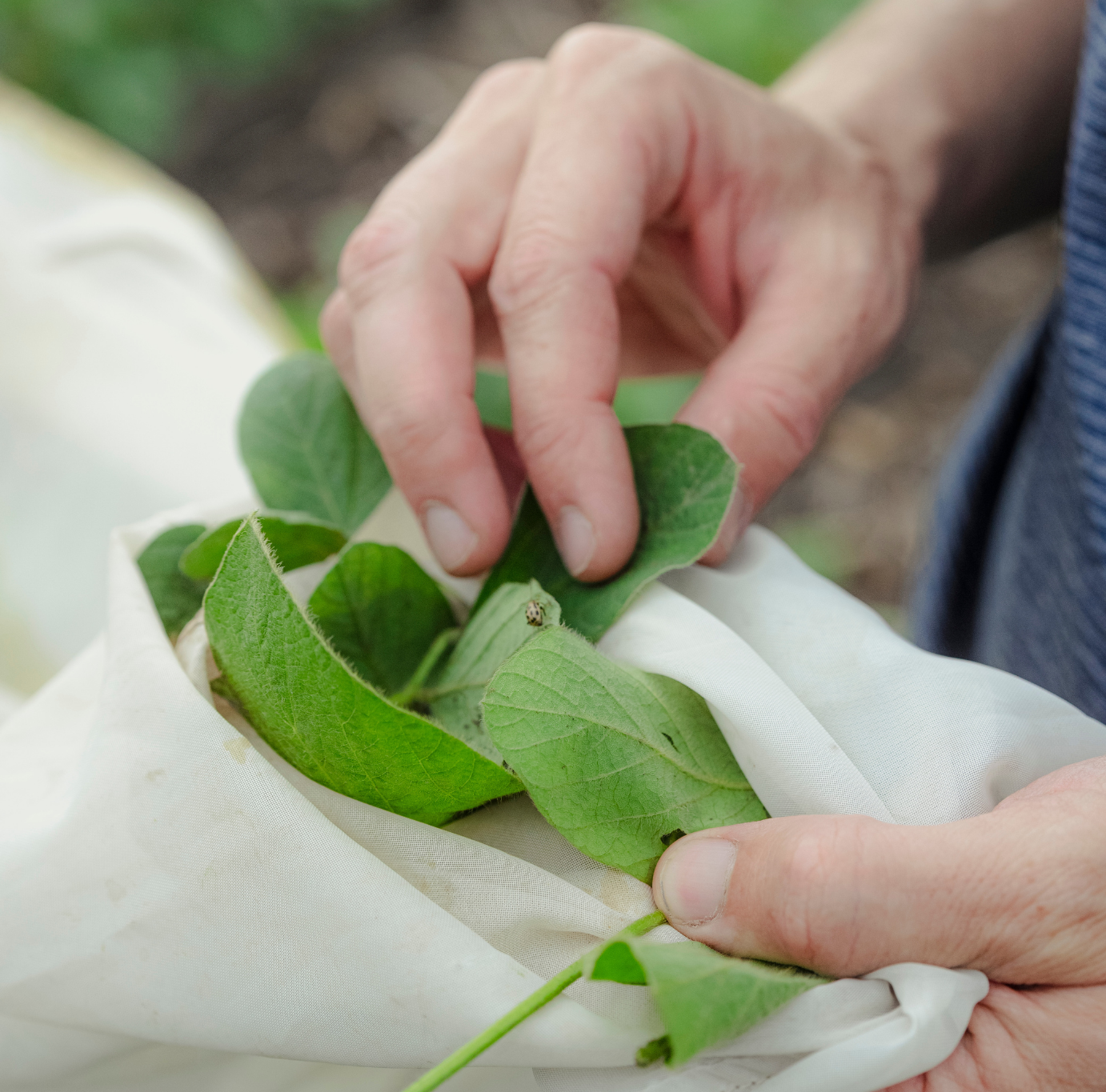
Insecticides are critical tools for insect pest management in soybean. However, in Illinois, we are blessed with pest populations that are relatively sporadic. (If you feel otherwise, our friends in the southern U.S. and South America would beg to differ.) In fact, most Illinois soybean fields in any given year will not have an economically damaging insect population.
While this should be a comforting thought, those sporadic insect populations are difficult to predict and expensive to scout, while insecticides are relatively cheap. As a result, insecticides are often used more as inexpensive insurance than in response to pest outbreaks in the field and are either applied to the seed or at a particular soybean growth stage, most often with a fungicide at pod formation, or R3.
Given how common these applications are, we wanted to understand how often they provided a positive return to the farmer.
In 2024 and 2025, we conducted 15 field experiments on research farms and on commercial soybean fields to determine how often insecticides applied at a growth stage or to the seed protected soybean yields relative to untreated plots. Pest populations were generally low, falling below established economic thresholds throughout the season at all sites. Perhaps not surprisingly, we saw no pattern of increased soybean yields where we used an insecticide at these sites. A few patterns did stand out:
- There were several locations where we successfully controlled large populations of bean leaf beetles when we sprayed an insecticide during seed formation (i.e., soybean growth stage R5). However, feeding on leaf tissue in the untreated plots remained below our economic threshold level in these fields (10% defoliation), and controlling these high beetle populations did not lead to increased yield.
- All eight of our experiments conducted on research farms included a seed-applied insecticide (imidacloprid). We saw a reduction in plant stand at one site and an increase in insect feeding at another site in plots without a seed treatment. However, we did not observe an increase in yield associated with the insecticide seed treatment at any site.
- While most foliar insecticides in Illinois are applied at growth stage R3, usually in combination with a fungicide, our insect counts at R3 were almost always very low. With soybean aphid no longer a frequent concern in Illinois, damaging insect populations at R3 are not common. When you consider that the average pyrethroid insecticide is effective in the field for maybe 7 – 10 days, it is unlikely that most of the insecticides we add to the spray tank at R3 do much good.
More detailed information on the insect counts and yield values that we observed are available in our annual reports from 2024 and 2025, published at https://go.illinois.edu/pestmanagementresearchreport. This research was funded by the Illinois Soybean Checkoff program.
We will continue this work in 2026 and hope to continue it going forward to provide evidence-based recommendations on when and how often insecticides are needed to optimize yields and profitability. In particular, it will be interesting to see what happens when we do encounter insect pest populations that approach or exceed our current economic threshold recommendations. Our ultimate goal is to provide informed recommendations to farmers on when an insecticide is likely to provide a positive return and when it would be better served to remain in the jug for another day.
Recent Articles
What makes Illinois soy stand out on the national and global stage? From our unmatched transportation network to innovative infrastructure projects, Illinois moves soy efficiently and effectively.
By
Where Illinois soy stands today - and where it's headed.
By IL Field & Bean Team