
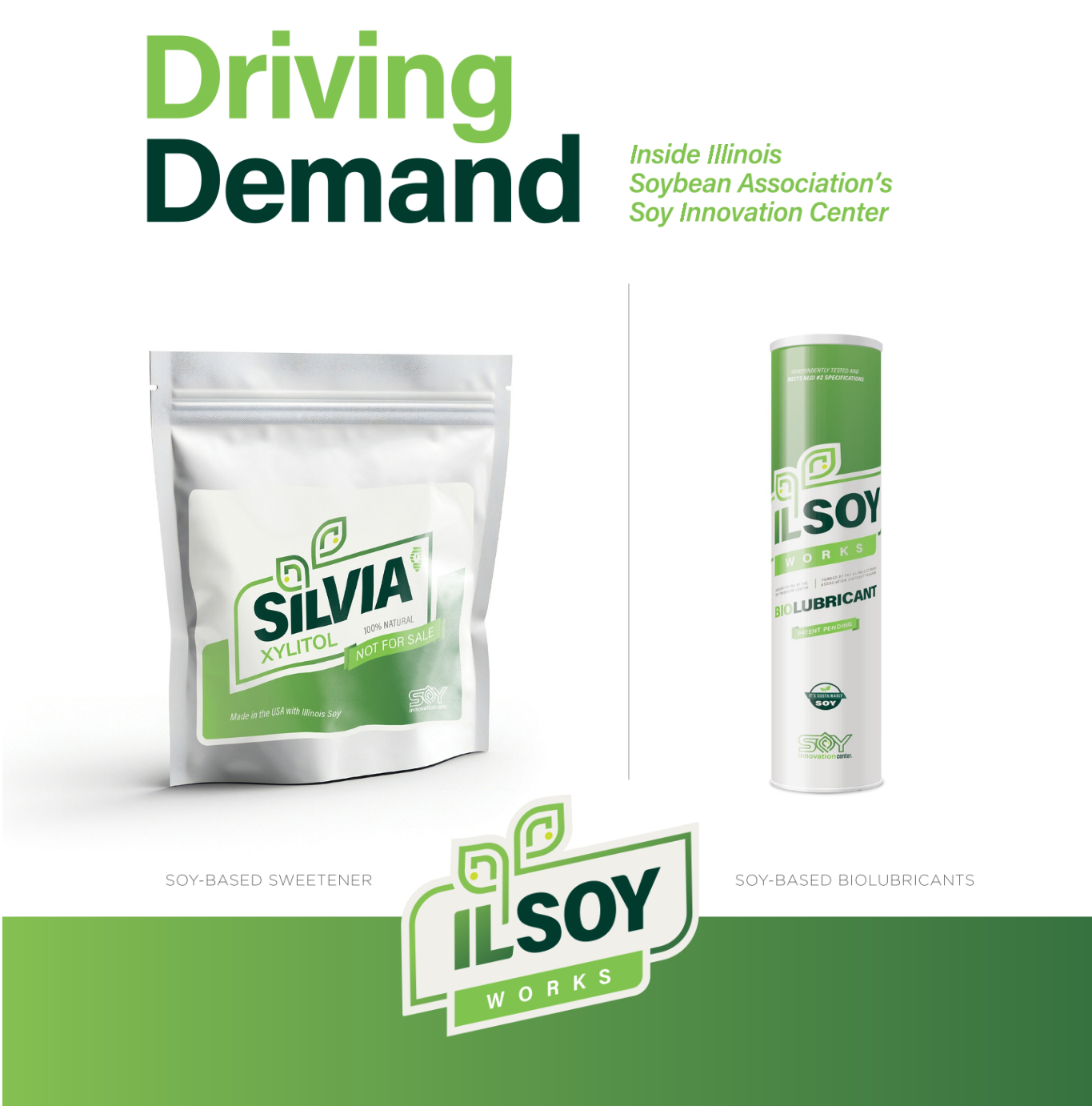
Innovation often begins with a simple question: What else can soy do? At the Illinois Soybean Association’s Soy Innovation Center (ISA’s SIC), we’re asking that question every day. Increasingly, the answers are opening doors to entirely new markets for Illinois soybeans.
The work underway at the SIC is about more than scientific curiosity. It’s about identifying new industrial-scale uses for soy that could strengthen demand, create manufacturing opportunities closer to home and ultimately support long-term profitability for Illinois soybean farmers.
In this article, we’ll take you inside the SIC’s approach to building new markets. We’ll share how two promising projects, soy-based lubricants and soy-derived xylitol, emerged from our research pipeline. And we’ll demonstrate what makes them commercially promising and how they could become meaningful new demand drivers for Illinois soybeans.
HOW THE SIC FINDS NEW SOY OPPORTUNITIES
The SIC exists to facilitate research, development and commercialization of new and innovative uses for soy at an industrial scale. The program is funded through the soybean checkoff.
One of the center’s key engines for innovation is the SpringBoard Challenge. This research competition is designed to stimulate the broader agtech economy and encourage entrepreneurs and scientists to explore new applications for soy-based materials.
Before any project receives checkoff investment, we evaluate it through a rigorous lens. Several core questions guide every decision:
- Does soy provide a real competitive advantage? We look beyond environmental benefits and ask whether soy truly performs better than other feedstocks for this application.
- Is the potential market large enough to matter? Internally, we call this our “move-the-pile” scorecard. If a product category can’t consume meaningful soybean volume, we pass on it.
- Does it align with where the U.S. economy is headed? We prioritize materials and technologies likely to matter in the next decade.
We’ve used these criteria during the SIC’s first 18 months to cast a wide net and explore opportunities across several categories: bioplastics, lubricants, PFAS substitutes, biopolymers and biofibers.
From that initial exploration, and after extensive review of existing industry work, we began our work focused on two particularly promising opportunities: biolubricants and xylitol.
SOY-BASED LUBRICANTS FOR FARM EQUIPMENT
Of the many opportunities we evaluated, lubricants stood out immediately for one practical reason: Our own members would be natural early adopters.
Farm equipment relies heavily on grease and other lubricants to protect moving parts from friction and wear. Today, nearly all commercially available products used in agriculture contain petroleum-derived ingredients and are rated under the NLGI-2 performance standard.
Yet soybean oil contains several properties that make it an exceptional lubricant ingredient:
- Its large triglyceride molecules create high viscosity, making it similar to the long-chain hydrocarbons used in petroleum-based lubricants.
- Soy offers best-in-class polarity, meaning it adheres exceptionally well to metal surfaces.
- It provides a compelling combination of performance, cost and sustainability advantages.
We knew that if this product met commercial standards, Illinois farmers could help generate the field data needed to bring it to market.
The journey has been far from simple. After several unsuccessful formulation attempts, we partnered with a Chicago-area manufacturer that developed a grease recipe using soybean oil that not only met but far exceeded NLGI performance standards.
In January, we delivered the first 100 pounds of soy-based grease to ISA board members for initial testing. The next step is scaling production toward approximately 15,000 pounds in time for preharvest greasing this fall, with a longer-term goal of producing 50,000 one-pound cartridges by the third quarter of 2026.
If even a modest share of the ag lubricant market adopts soy-based grease, the potential demand impact becomes meaningful. Our early projections suggest Illinois farmer use alone could represent roughly 66,667 bushels of soybean demand annually at a 5% market capture.
FROM SOYBEAN HULLS TO HEALTHY SWEETENERS
If lubricants emerged from strategic planning, the second project—soy-derived xylitol— began with an unexpected moment of serendipity.
During a tour of the U.S. Department of Agriculture research facility in Peoria, scientists explained that the lab had spent decades studying different agricultural feedstocks for potential industrial applications. Curious to learn more, we asked if they had a database summarizing that research. Sure enough, they did, and they agreed to share it with us.
After spending several Saturdays exploring its contents, we identified a fascinating opportunity that had never been pursued commercially. Researchers had previously extracted xylitol, a widely used sugar substitute, from corn cobs, but no one had attempted to produce it from soy-based materials.
We launched a project to explore that possibility using soybean hulls as the input material.
The choice was deliberate. Soybean hulls are often considered one of the lower-value components of the soybean processing stream. They’re commonly used as animal feed filler. Yet they contain hemicellulose, a compound well-suited to sugar extraction processes.
This humble byproduct, which as of this writing sells for about $100 per ton, might hold the key to producing a high-value ingredient used in products such as mouthwash, sugar-free gum, toothpaste and other sugar-free foods and oral care products.
Xylitol also offers several compelling consumer health advantages. Unlike traditional sugar, it doesn’t trigger an insulin response, making it suitable for people with diabetes. Even more remarkably, it can help prevent tooth decay.
The research has already reached a promising milestone. Phase 1 of the project concluded in December 2025 with the successful production of small quantities of xylitol from soybean hulls. The team is now working to scale output to 10 kilograms while evaluating manufacturing costs and commercial feasibility.
North America already represents the world’s largest xylitol market, consuming more than 20,000 tons annually, much of it imported from China. Several industry partners including a major sugar-free product manufacturer and a national consulting firm specializing in sweetener formulations have expressed strong interest in establishing a domestic supply chain.
If the technology proves commercially viable, the potential demand impact could be substantial. At just 5% market penetration, soy-based xylitol could require approximately 2.7 million bushels of soybeans annually.
Commercial-scale production is currently targeted for 2027 following additional testing, food safety certifications and pilot-scale development throughout 2026.
TURNING INNOVATION INTO MARKETS
Discovering promising technologies is only the SIC’s first step. Transforming them into viable products requires extensive work across manufacturing, logistics and supply chains.
One challenge we quickly encountered while developing soy-based lubricants illustrates this reality. Illinois once had a large-scale grease manufacturing facility, but a fire destroyed the plant several years ago. Today, no large-scale grease manufacturing remains in the state.
Building a supply chain required creative problem solving. At one point, the logistics plan involved sourcing empty cartridges from Canada, manufacturing grease in Wisconsin, shipping drums to Iowa for packaging and finally returning finished cartridges to Illinois retailers.
Through persistent work with partners, we have simplified the process to a two-step system with the ultimate goal of bringing the entire production chain back to Illinois.
Like all new ventures, some projects might encounter obstacles or even fail. But our focus continues to be identifying opportunities where soy can compete and build new demand for Illinois farmers. The SIC exists because Illinois growers invest checkoff dollars to explore these possibilities.
NEW FRONTIERS FOR SOY-BASED INNOVATION
Lubricants and xylitol represent just the beginning of the SIC’s research pipeline. Several additional projects and opportunities are already underway, including:
- PFAS substitutes: biodegradable, soy-protein-based coatings designed to provide waterproofing without the environmental concerns associated with conventional PFAS chemicals.
- Soy-based magnets: early-stage research exploring unique properties of soy materials in laboratory-produced magnetic applications.
- Other commercial products: projects exploring soy-based plastics, rare-earth mineral processing and other technologies emerging from the 2025 SpringBoard Challenge.
- Illinois farmer engagement: Farmers who want to stay involved can play a role in identifying potential partners. The SIC periodically seeks connections to manufacturers, logistics providers, storage partners and other collaborators who can help bring innovations to market. If you would like to help us in this process, email soyinnovationcenter@ilsoy.org and we will add you to our mailing list to which we will send queries.
Innovation rarely follows a straight line. But with curiosity, persistence and the continued support of Illinois soybean farmers, the SIC will work to unlock the next wave of soybean demand, one breakthrough at a time.
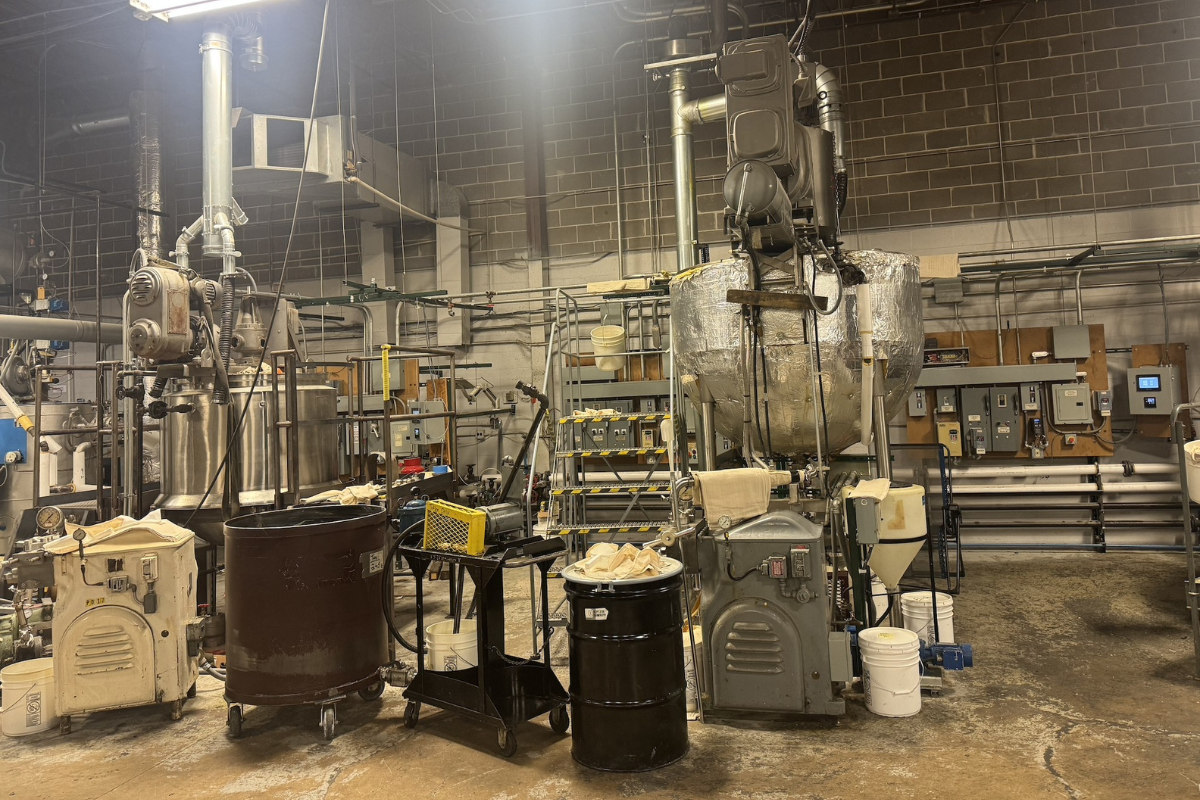
Photo credit: Badri Narasimhan, Soy Innovation Center
Recent Articles
What makes Illinois soy stand out on the national and global stage? From our unmatched transportation network to innovative infrastructure projects, Illinois moves soy efficiently and effectively.
By
Where Illinois soy stands today - and where it's headed.
By IL Field & Bean Team