

Conservation has never been a hard sell to Illinois soybean farmers. You care deeply about the land you work. Many of you are farming ground your parents or grandparents farmed before you. Taking care of that soil is already built into your mindset.
What is not always acknowledged by those outside of agriculture is the business side of conservation. That’s where farmers are running the numbers, looking at tight margins and asking an important question: Does conservation make financial sense? With input costs remaining high, that question matters.
And it’s a fair question. In fact, it’s one this issue of Illinois Field & Bean is designed to explore.
Conservation matters. ISA believes that. But conservation is only truly sustainable when it also makes sense as a business decision. A practice that improves soil health but drives an operation toward red ink is not a long-term solution. Eventually, the numbers have to pencil out. The goal is to find approaches that work agronomically, economically and operationally, year after year.
Of course, what works is going to look different from farm to farm and region to region. Every conservation practice has to earn its spot, starting with whether it fits your soil and your operation. A practice that works well on one Illinois farm may require a different approach just a few counties away. Soil type, drainage, weather, crop rotation and available equipment can all influence what makes sense. Effective stewardship means adapting tools like cover crops, buffer strips, reduced tillage and split-nitrogen applications to the realities of your operation.
Farming has to be profitable. ISA is a farmer-led organization, and that means pursuing conservation in a way that recognizes the financial realities farmers face every day. Profitability is not a dirty word. It is what keeps farms viable and, for many families, makes it possible to pass them on to the next generation. To me, that’s an important part of what sustainability really means.
At the same time, the case for conservation has gotten stronger in recent years. Healthy soils hold moisture better, which matters when a dry summer hits. Good water management pays dividends whether conditions are wet or dry. And the market is paying attention. Buyers, processors and export customers are asking more questions about how soybeans are grown. That can create opportunities for farmers who are already putting conservation practices to work.
ISA’s job is to help close the gap between conservation’s promise, the practical reality of putting it to work on your farm and the potential opportunities in the marketplace. We do that through checkoff-funded research that generates real data from Illinois fields, including work shared through www.FieldAdvisor.org on topics like cover crop timing, residue management and soil health.
Through a formal partnership with USDA-NRCS, we are connecting farmers with practical guidance and helping them navigate the funding programs available to put those practices in place. We also offer workshops, field days and downloadable resources to help farmers prepare for conversations with their local NRCS office.
Ultimately, the best conservation practice is the one you can make work on your acres, in your financial situation, with the equipment and labor you have. Talk to your agronomist, your neighbors and other trusted advisors who have tried these practices. Ask the tough questions. Run the numbers. And find what works for your farm.
You can also “Grow Your Ground Game” by visiting www.ilsoy.org/conservation. There, you’ll find resources your checkoff dollars have helped build to support those decisions. And if you have questions, reach out to us directly. As always, it’s our honor to support and serve you.
Recent Articles
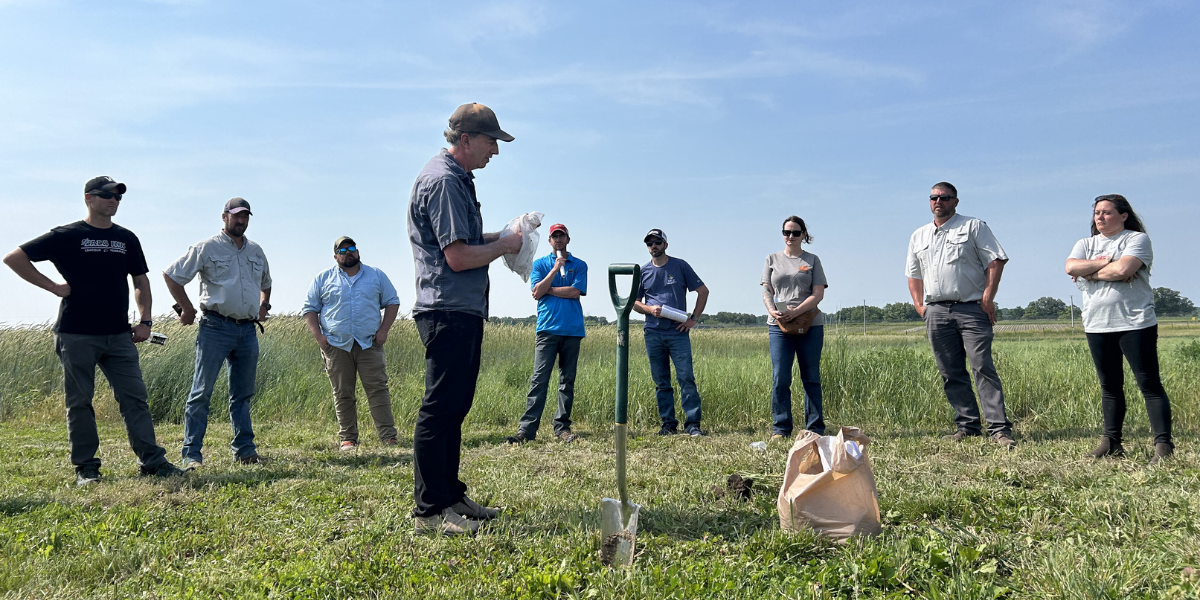
Discover how Illinois is developing a new crop of soil health leaders.
By IL Field & Bean Team