
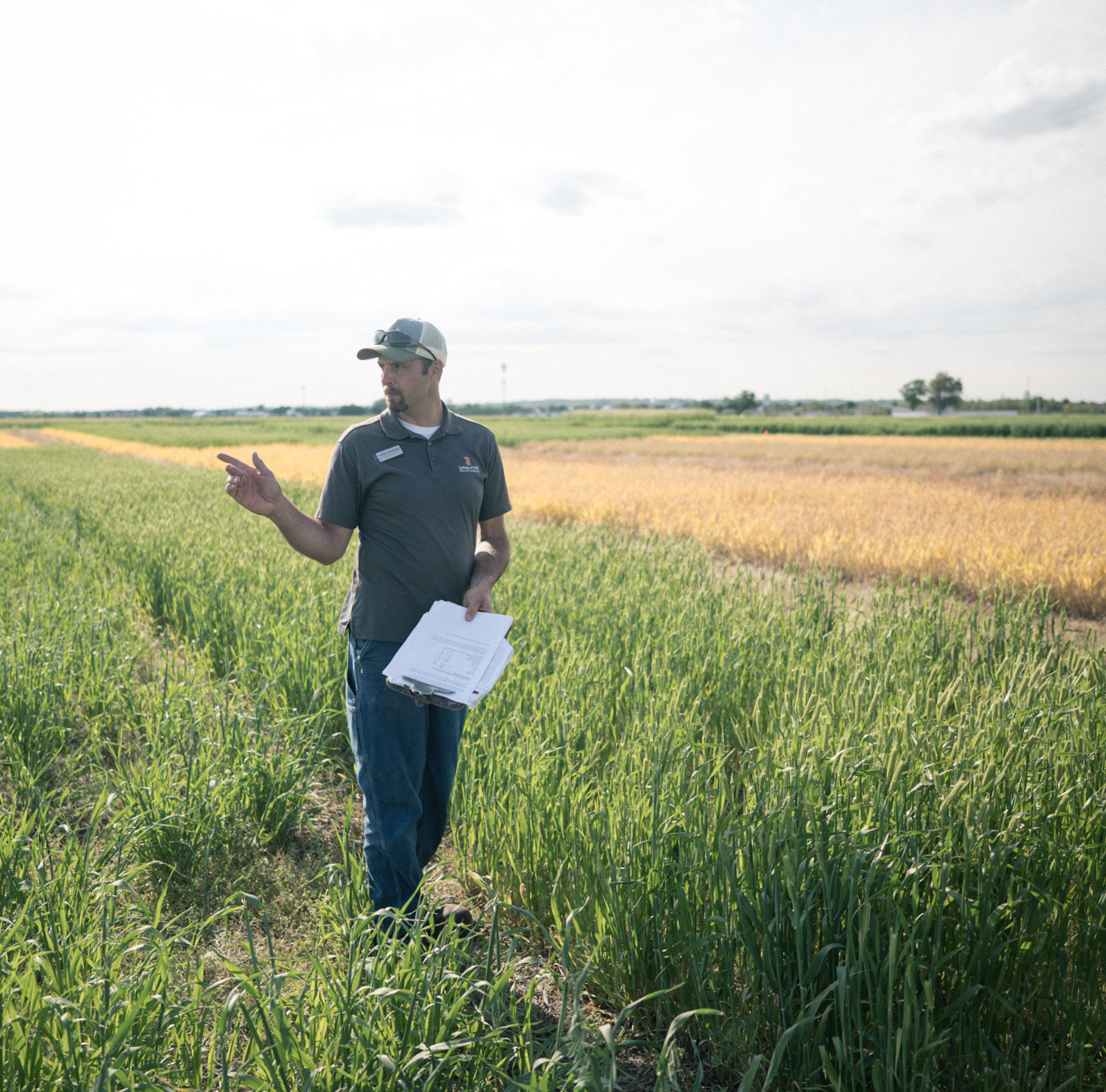
Extension expert Nathan Johanning tackles the questions they hear most often from farmers: cover crop termination, nutrient management, erosion, compaction, economics, etc.
While many soybean farmers in Illinois believe that conservation practices are beneficial to the soil, nutrient management, and more, many are still skeptical and have questions. They are unsure whether conservation practices will work on their operation, whether they are worth it financially, and how hard it might be to implement these practices. Farmers can also be confused or overwhelmed by the number of options out there.
But beyond that, what are the real questions farmers are asking about conservation practices? Here’s what Nathan Johanning, a farmer and University of Illinois Extension Commercial Agriculture Specialist, has to say.
Q: How can farmers protect nutrients and get more value from their fertilizer investment?
According to Nathan Johanning, nutrient conservation continues to be increasingly on farmers’ minds because of continuously rising fertilizer and input costs. Rather than allowing valuable nutrients to sit vulnerable to loss between growing seasons, Johanning said cover crops can help keep those nutrients cycling within the system because they are able to “hold on to nutrients” throughout the winter and gradually release them back into the soil.
Johanning also emphasized that farmers do not need high seeding rates or expensive cover crop programs to see benefits. Relatively low rates of cereal grain cover crops can help capture nutrients while also providing benefits such as erosion control and weed suppression. He noted that incorporating cover crops can create a more continuous nutrient cycle, reducing the amount of nutrients left exposed to weather and environmental losses between cash crops.
Q: What is the best way for farmers to implement cover crops without taking on a lot of risk?
Johanning recommends starting simple is best. Rather than investing heavily in complex seed mixes or changing an entire farming operation overnight, he encourages producers to start with proven, straightforward practices that allow them to learn about the system while minimizing risk. The practices he generally recommends starting with are:
- Use cereal rye, wheat or another type of small grain
- Keep seeding rates relatively low
- Terminate the cover crop a few weeks before planting
- Start with a small plot of land before expanding to full fields
Johanning cautions against trying every conservation practice at once, noting that many successful cover crop users began with a basic system and refined it over time. While practices such as planting green have gained attention in recent years, he believes growers new to cover crops should first focus on establishing a simple, repeatable program that works within their existing management system.
“Don’t try everything at once,” Johanning says. “I don’t necessarily always advocate planting green on the first go-around.” By starting with a low-risk approach and making adjustments over time, farmers can learn what works best for their operation while capitalizing on many of the benefits these practices can provide.
Q: Can cover crops help with weed resistance?
Johanning reported that the impact of cover crops on weed resistance has become one of the most interesting emerging questions in conservation, particularly as herbicide-resistant weeds continue to challenge crop production across Illinois. Increasing weed resistance, particularly waterhemp pressure, has been driving more interest in cover crops.
“There’s a lot of interest in how cover crops can be a beneficial asset to managing weeds,” Johanning said. “Methods that can reduce the pressure on herbicide performance and help farmers out a little bit are pushing them more towards cover crops.”
According to Johanning, cereal rye has gained interest because it provides benefits beyond soil health and erosion control. When managed properly, it can help suppress early-season weed growth. As farmers look for ways to strengthen weed control programs and preserve the effectiveness of existing herbicide tools, cover crops are increasingly being viewed as an additional layer of defense rather than a standalone solution.
Q: Will conservation practices actually pay for themselves?
The economics of conservation remains one of the most common questions Johanning hears from producers. While the values of conservation practices are difficult to accurately quantify, he says producers often see benefits such as better weed control, reduced erosion, less time spent repairing erosion damage, and long-term improvements to soil productivity.
Johanning acknowledged that conservation practices do not always generate an immediate return after the first growing season. Instead, many of the economic benefits accumulate over several years as soil structure improves, nutrient cycling becomes more efficient and erosion losses are reduced.
For that reason, he encourages farmers to evaluate conservation investments with a long-term perspective rather than expecting instant results. “A lot of farmers who have been in this have really been in it for the long haul, and they see the benefits of adopting conservation practices,” Johanning said.
Q: What’s the most cost-effective conservation practice to start with?
For farmers interested in beginning to adopt conservation practices, Johanning recommends starting with no-till, reduced tillage, or cover crops, all of which can provide meaningful benefits without requiring a major overhaul of an operation.
One of the points he stresses is that producers don’t necessarily need expensive mixes or full-field adoption right away in order to see the benefits of conservation. Instead, starting with smaller acres can help them target highly erodible areas, compacted headlands, or problem spots. Rather than focusing on perfection, Johanning encourages growers to look for practical opportunities to improve soil protection, reduce erosion and enhance long-term productivity in ways that fit their operation and budget.
Johanning says the biggest point he wants to make to farmers is that adopting conservation practices does not mean they have to give up everything they have been doing and adopt new practices all at once.
“Just take a little time to think about some concepts,” Johanning says. “I think there are certainly areas that farmers can get into that are not super high-risk. There are lots of things you can do that are hardly any different than what they are doing. You’re just adding an extra level in there.”
More information about Illinois Soybean Association’s conservation efforts and research can be found at www.ilsoy.org/conservation/ and fieldadvisor.org/.
Recent Articles
Discover how Illinois is developing a new crop of soil health leaders.
By IL Field & Bean Team